
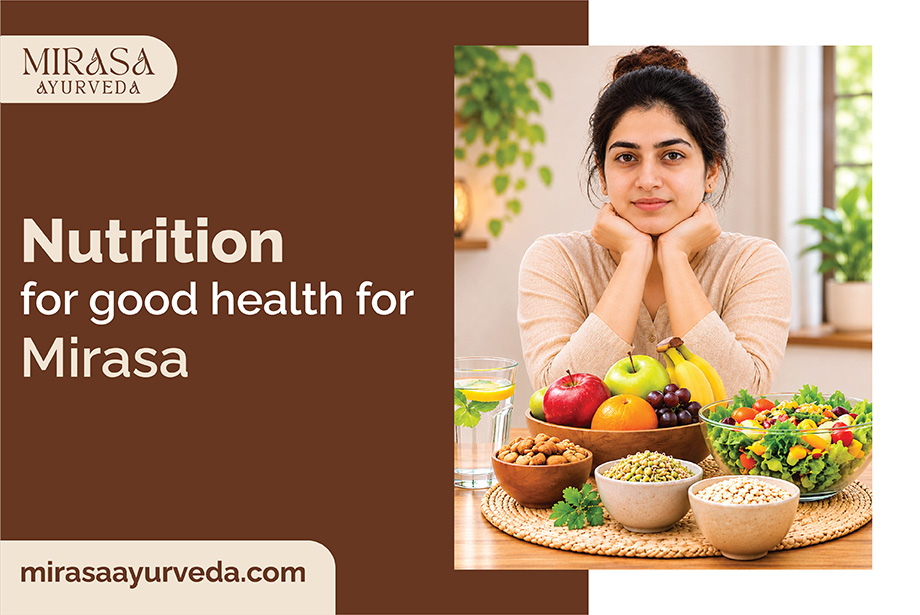
In a world of crash diets and calorie counters and ever-changing food trends, one question keeps coming back: What does it really mean to eat well? Ayurveda, India’s 5,000-year-old science of life, has answered this for centuries. At Mirasa Ayurveda, we believe that nutrition for good health is not about restriction. It is about eating the right food, in the right amount, at the right time, and in tune with your own body.
This healthy nutrition guide brings together classical Ayurvedic principles and simple, practical steps you can start today.
Modern science describes nutrition as the process of taking in and using food for growth, energy and repair. Ayurveda goes further. It says that health is a balance of the body, mind, senses and spirit, and food (Ahara) is one of the three pillars of life, along with sleep (Nidra) and balanced living (Brahmacharya).
So when you ask people, “What are health and nutrition? “The Ayurvedic answer is this. Health is a state of balance, and nutrition is the daily practice that maintains that balance. The classical texts describe a healthy person as one whose doshas are balanced, whose digestive fire (Agni) is steady, whose tissues (dhatus) are well nourished, and whose mind and senses are content.
Ayurveda says it is not whatever you eat but how well you digest it. With a strong agni, you can convert the food into energy and vitality. A weak Agni can leave behind Ama, a sticky residue of undigested food that Ayurveda links to heaviness, sluggishness and imbalance.
Simple ways to support Agni:
Ayurveda teaches that no single diet suits everyone. Your constitution (Prakriti) is made up of three doshas: Vata, Pitta and Kapha. Eating according to your dominant dosha is one of the most powerful ways to follow a nutritional diet that truly works for you.
Vata (air and space): Tends to be light, dry and quick-moving. Favour warm, moist, grounding foods such as soups, stews, cooked grains, ghee, root vegetables and sweet, ripe fruits. Reduce raw, cold and very dry foods.
Pitta (fire and water): Tends to run warm, with a strong appetite and sharp digestion. Favour cooling, fresh foods such as cucumber, coconut, leafy greens, sweet fruits, basmati rice and mint. Go easy on very spicy, sour, salty and fried foods.
Kapha (earth and water): stable, slow and heavy usually. You can choose warm, spiced food such as lentils, bitter greens, millets, pungent spices and seasonal vegetables. Reduce heavy dairy, sweets and oily, fried foods.
An Ayurvedic balanced plate consists of all six tastes, which are sweet, sour, salty, pungent, bitter and astringent. Each taste affects the doshas in a different way, and a meal that includes all six tastes is typically more satisfying, which can naturally curb cravings.
A simple example is a thali with rice or roti (sweet), dal (sweet and sour), a squeeze of lemon (sour), a pinch of rock salt (salty), spiced vegetables (pungent), bitter greens like methi or karela and a spoonful of curd or chutney on the side.
There is a specific nutritional value to any food you consume, and the benefits of proper nutrition start to reflect with the right choice you have opted for. Talking about the advantages of good nutrition, it mainly includes:
These are the benefits of a nutritional diet that go far beyond the scale. They build overall well-being from within.
If you are wondering how you can improve your diet, start small. Pick two or three of these habits and build from there.
Morning: Warm water and a light breakfast like stewed apples with cinnamon, vegetable, poha or oats cooked with a little ghee
Lunch: A wholesome plate of rice or roti, dal, seasonal vegetables, a small salad and roasted cumin buttermilk
Evening: Light snack like roasted makhana, soaked nuts or fresh fruit. Herbal Tea of Tulsi, Ginger or Fennel
Dinner: A simple and warm meal such as moong dal khichdi or vegetable soup
What Ayurveda and modern nutrition science share are eating whole foods, variety, limiting heavily processed foods and being consistent. Ayurveda personalises based on your constitution, digestion, season and lifestyle. This is why an Ayurvedic healthy nutrition guide feels more like a conversation with your body than a rule book.
Good health starts with what you eat, but it is built on awareness, routine and balance. Learn your dosha, tend to your Agni, eat seasonal food, and slow down at mealtimes, and you will build a way of eating that holds you for life.
And it is this timeless wisdom – natural, balanced and personalised care – that Mirasa Ayurveda is all about. Whether you are beginning your wellness journey or looking to refine it, we will help you find nutrition for good health, one mindful meal at a time.